I build AI products
that actually ship.
I scored 505,140 businesses with an engine I designed, built and ran myself. I put AI voice agents on live phone lines; inbound answer, CRM write-back, and a demo you can call. I took a fintech platform from ideation to architecture spec to app and browser extension. Solo, by directing coding agents, and always from the first customer conversation through to production.
Things I have built.
Five products across AI infrastructure, proptech, fintech, and consulting. Some are live, one I stopped on purpose, and that one taught me the most.
GradeForAI
AI agents are beginning to transact on people's behalf. Booking the appointment, placing the order, choosing the vendor. An agent can only act on a business whose site it can navigate, read accurately, and complete a transaction on, and most businesses fail at least one of those. I measured the gap and built the engine that scores it.
Roughly 16,700 lines of Python. A six dimension scoring engine covering agent compatibility, transaction readiness, agentic commerce readiness, operational data structure, data accuracy, and competitive position, calibrated per industry so a law firm and a plumbing company are each judged against the right standard. Around the engine: a harvesting pipeline, a parallel scorer, a SQLite store holding historical trend data, generated client PDF reports, an admin dashboard, and scheduled re-scoring running as systemd services on a VPS, unattended in production for eight months. The platform is public; the engine, its weights, and the dataset are not.
I stopped selling it as a standalone product when Cloudflare began giving comparable readiness signals away free. The work did not go in a drawer. The scoring engine and the dataset moved into CloudAurum, where they now surface operational gaps for consulting clients.
Proffio
An AI operating system for real estate agents and brokerages. I spent years inside real estate transactions and watched the same thing every time: agents lose deals to follow up they never got around to, and brokers have no view into it until the pipeline is already dry.
Proffio is designed to run the follow up for them. Running today: thirty routed screens over a 118 table Postgres schema behind 245 row level security policies, a three tier permission model for agents, teams, and brokers enforced in SQL rather than in the interface, and twenty four Supabase edge functions. I shipped a cross tenant leak in that permission model, a policy that let any signed in user read every client record, caught it, and replaced it with a team scoped policy. Finding my own security bug is the part of this I would defend hardest.
Designed and scaffolded but not wired: roughly seventy five further screens and more than twenty AI services, covering lead quality, client health, deal risk, re-engagement, sentiment across conversations, drafting the next message, and voice commands so an agent can work between showings. Mobile packaging is configured, not built. That layer is where the remaining work is, and it is deliberately the part I have not shipped.
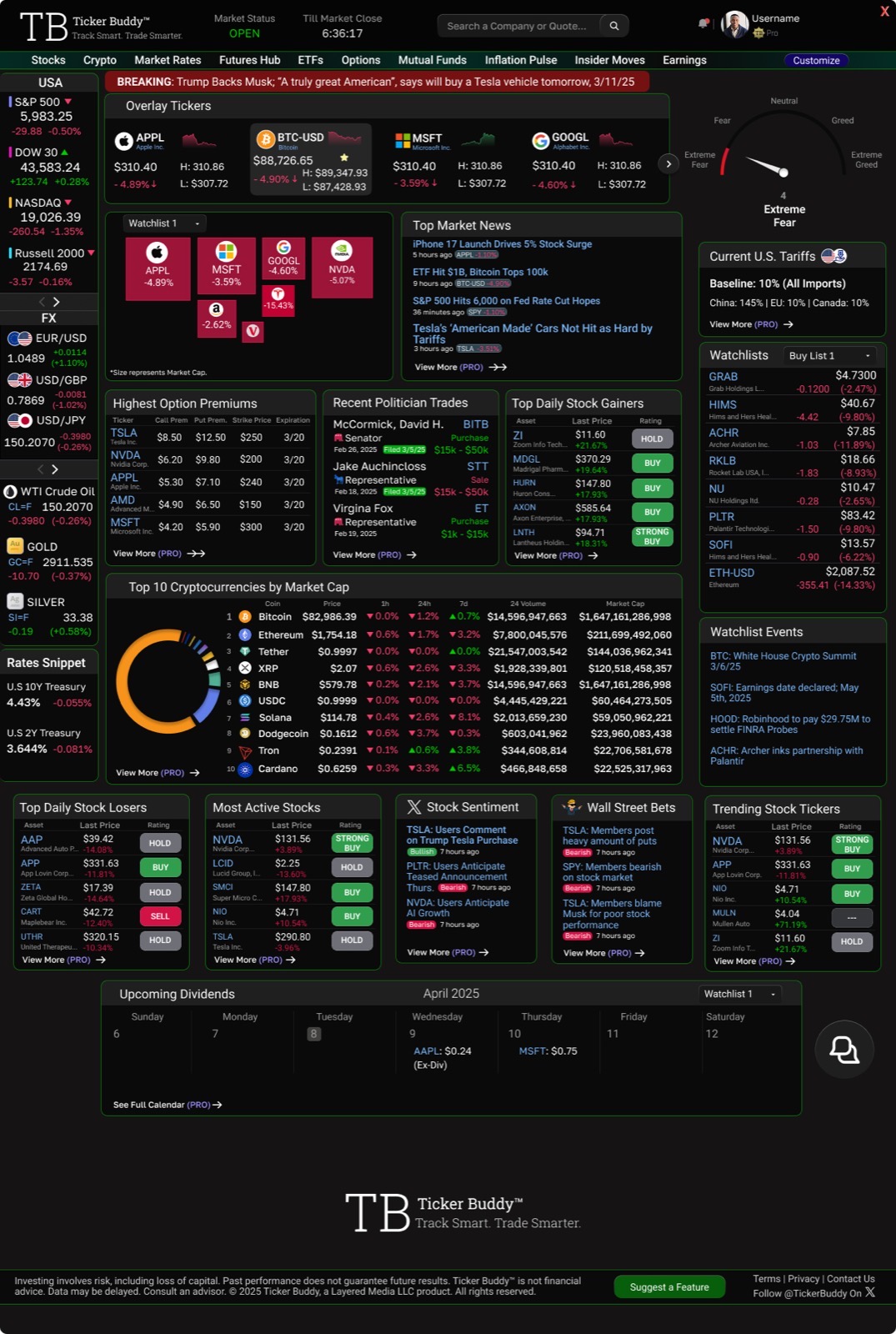
Ticker Buddy
Traders keep a dozen tabs open because nothing puts market data, macro signals, and social sentiment in one place. Ticker Buddy was my answer, built to carry the depth of Bloomberg with the clarity of Robinhood.
I owned it from thesis to working code. A React and TypeScript application on Supabase, plus a Manifest V3 browser extension for the signature always on ticker overlay, so the product lives inside a trader's workflow instead of asking them to visit it.
The work I would put in front of an engineer is the data layer. Live quotes come from two upstreams I do not control, so the edge function wraps them in endpoint failover, a tiered retry ladder with explicit rate-limit handling, and three separately tuned caches including negative caching so a dead symbol cannot be hammered. Plan limits live in a Postgres trigger rather than the client. Quota telemetry routes to three destinations as headroom drops, independent thresholds rather than a ladder, and Sentry runs in production with text masking and session replay. Preparing the repo for review, I found and fixed three defects of my own: an authorization gap that let a user raise their own plan, error-handling branches that had been silently unreachable, and a quota alert guarded so that it stayed silent at exactly zero remaining, the one state worth paging on. All three are documented in the repo rather than quietly patched.
The earliest piece was a separate one: a D3 heat map built eight months before the web app, a market-cap-weighted treemap across five views including an ETF map and a World map nested region to country to ticker. It joins two Financial Modeling Prep endpoints, because index membership and sector live on one and prices live on another. Hitting real rate limits there produced the Express proxy behind it, with request batching, backoff, caching, and input validation. It also priced the project: roughly twelve thousand a month in licensed feeds to run the full platform, against the sixty-nine dollar plan the prototype was on. It lives in the same repo and was never wired into the app.
The intelligence layer was the differentiator. Instead of pushing an identical feed to everyone, the system was designed to learn from a user's watchlists and in-app behavior, build a model of what they actually hold and care about, then tune alert thresholds and rank relevance against it. Someone holding a specific position hears about what moves that position rather than general market noise, with NLP sentiment and volatility signals feeding the same model. I specified it in full and then held the build, because doing it properly meant licensing market data at a cost that needed capital behind it. Half-shipping the differentiator was not worth it, so the project is paused pending that raise rather than abandoned.
Underneath it: a five layer architecture running from data ingestion through AI processing to the user ecosystem, specced against Polygon.io, FMP, and CME. A full Figma design system iterated V3 through V4.2, with further dashboards designed and specced but never built, pricing, positioning against Bloomberg, TradingView, and Quartr, a 13 section whitepaper, and a trademark application in three classes that cleared USPTO examination with no conflicting marks found and advanced to a Notice of Allowance, which never registered and lapsed only because a statement of use was due within six months and the product was never sold. I still hold tickerbuddy.co, usetickerbuddy.com, and tickerbuddy.app.
CloudAurum
Most businesses leak revenue in places they cannot see. Leads that never get answered. Work done by hand that should not be. Data scattered across five tools nobody reconciles. CloudAurum finds the leak, then builds only what closes it.
Every engagement opens with a diagnostic, and the diagnostic runs on my own tooling: the scoring engine and 505,140-business dataset I built at GradeForAI, folded in here. I map how the operation actually runs, quantify what each gap costs in revenue, and prescribe the build. The builds I take on range from AI voice and SMS agents that capture missed demand, to reactivation campaigns that recover dormant customers, to workflow automation and systems consolidation. I run the discovery, scope and price the work, architect the integration, and deliver it. The first engagements are case-study diagnostics delivered at no fee, and the diagnostic is paid from there. So far I have delivered a diagnostic and written report for a State Farm agency and onboarded a multi-location dental group. A voice agent demo is live. Call Amy, the CloudAurum AI front desk, at +1 (817) 519-8552.
OptionPulse
A predictive options analytics platform for retail options traders. I built the full product surface in React and TypeScript on Supabase, thirteen screens covering the options chain, watchlist, alerts, journal, education and community, and put it in front of real traders in 2025 for early interest. The real engineering is one Supabase edge function: an Alpha Vantage options-chain service behind a staleness-aware cache, refreshed by an external scheduler because the free tier has no cron, with a three-ticker allowlist so an open symbol parameter could not burn a rate-limited vendor key. The rest of the app is prototype-stage and reads fixtures. The alerts and the auth were never more than mock, and the repo says so.
Then I killed it. Market data licensing cost more than the model could carry at independent scale, and publishing predictive financial signals carries regulatory exposure I was not prepared to underwrite. The decision took longer than the build. Choosing not to ship a product you have already built is the judgment I would defend in any interview.
How I work.
Product instinct, hands on building, and the ability to sit in front of a customer. That third one is rarer than it should be.
Building with AI Agents
- Claude Code, Codex, Cursor, Grok, Lovable
- Spec-driven development with coding agents
- Multi-agent workflows and subagents
- Self-hosted autonomous agents (OpenClaw)
- Shipped in Python, TypeScript, React, SQL
- Agent protocols: llms.txt, agent.json, UCP, ACP, MCP
Product & Systems
- Discovery and problem framing
- Multi-layer systems architecture
- Data pipelines and scoring models
- Figma, UX and interface design
- Roadmapping, scoping, pricing
- Competitive positioning
Customer & GTM
- Solutions consulting and demos
- Technical storytelling
- On camera for national brands (SAG-AFTRA)
- Growth and paid acquisition
- Brand development
- Full cycle B2B sales
The short version.
I took an unusual route in. I am a SAG-AFTRA actor, I ran growth marketing next to national brands, and I have closed $6M+ in real estate as sole agent of record, work I still take on. Then I started building software with AI tooling and have not stopped since.
I build by directing AI coding agents. Claude Code, Codex, Cursor, Grok, and Lovable, plus an autonomous agent I set up and run myself. I write the spec, design the architecture, drive the implementation, and review what comes back. It is why one person has built a 16,700 line data platform, live voice agents on real phone lines, a React application with a browser extension, and an options analytics prototype I later shut down on purpose.
This is how software gets built now, and I have been working this way since before it was standard. What I bring is the judgment layer: knowing what to build, how to structure it, and when to stop.
I am looking for a defined seat on a team where discovery, the build, and the customer meet in one role: solutions engineering, sales engineering, or AI implementation.